

Titan Sports: Digital, Analog, Visible – How Trading Cards Are Re-telling Archery
Bogensport Magazin


By Anna Lena Gangluff
Preview from BOGENSPORT Magazine Issue 1/2026
International archery has been producing outstanding athletes for years – Olympic medals, world records and decades-long careers included. Yet visibility and sustainable marketing remain limited. In 2025, Titan Sports launched a project that addresses exactly this gap: high-quality trading cards, digital extensions and a clear focus on the athletes themselves. In conversation with editorial assistant Ferah Noor and author Anna Lena Gangluff, Vanessa and Brody from Titan Sports explain how an idea turned into a licensed product – a discussion about design, idealism and the reality of a young project.
Info:
Tradition Meets Technology: Collectible Card Culture in Germany
Collectible cards and stickers have held a firm place in German pop and sports culture for decades. At the latest with Panini albums for Football World Cups and European Championships, swapping, collecting and completing albums has been part of childhood for many generations – and no longer just for children. Adults, too, invest time and money in complete albums, special editions or limited card series. At the same time, a strong collecting culture has developed in recent years around trading card games such as Pokémon. Pokémon cards are now among the most widely collected
cards worldwide and, depending on condition and rarity, can achieve high market values. This growing interest is reflected not only in retail, but also in the media: collectible cards are increasingly discussed as cultural assets, collector’s items or even long-term
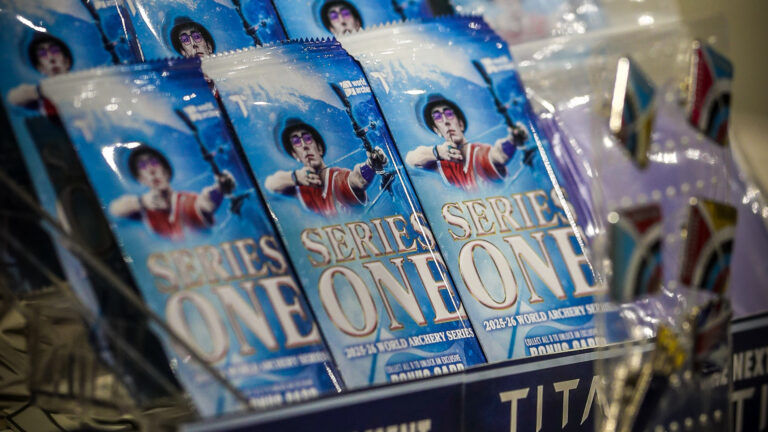
investments. Against this backdrop, the idea of rethinking collectible cards in a niche sport such as archery is not a break with tradition – but rather an evolution. Projects like Titan Sports build on familiar collecting mechanics and expand them with technological elements. Through NFC technology, a „digital twin“ of the physical card is created, offering additional content, interaction and new layers of experience. During our research into special gift ideas in December, we first came across the cards via social media. The combination of high-quality design, technological extension and a clear focus on the athletes quickly caught our attention – and ultimately led to the conversation with Vanessa and Brody.
A Gap in the System
Titan Sports did not emerge from a business plan. The starting point was a simple, recurring observation: archery produces world-class athletes – yet for the public, their
stories often end with the final arrow of a competition.
Vanessa puts this thought very directly in the interview. The motivation was never to simply create another product, but to build something that genuinely benefits the sport. Archery has very few formats in which athletes become visible beyond results alone. That was exactly where she saw a gap.
When she lost her job in the tech sector at the beginning of 2025, the nature of this idea
changed. What had been a concept became a concrete project. „I put all my energy into it and looked at what was possible,“ she says in retrospect. Time, experience and professional skills suddenly flowed entirely into a project that until then had been more theoretical.
The first concrete idea came from Matt, a friend who later joined the team and who works intensively with NFC technology. It quickly became clear that this was not meant to be a gimmick. If collectible cards were to be created for archery, they had to meet high standards: officially licensed, high-quality production and clearly rooted in the sport. For Vanessa, it was important from the outset that this would not be a project imposed from outside, but one developed from within archery itself.
The Team Behind Titan Sports
The Titan Sports team consists of five people spread across several locations in North and Central America. Vanessa works from Canada, Brody is based in Los Angeles, and the other team members – Abdul, Mike and Matt – are also located in different places. „None of us is earning money from this at the moment. We all have other jobs,“ Vanessa says openly. The first series was financed entirely from personal savings, which adds both pressure and motivation.
Brody, Creative Director and Lead Designer, is new to archery. „Vanessa showed me videos and explained how the sport works – and also how little money many athletes make,“ he recalls. It quickly became clear to him that he wanted to contribute his design experience. He is responsible for the card design, production coordination and large parts of the visual execution.
Vanessa describes the team dynamic as intense but flexible: despite the geographical distance, they work closely together, often via video calls and shared documents. For certain milestones, Vanessa also travels in person – for example to Los Angeles, to work directly with Brody on layouts and production issues. „Sometimes it’s these short but very focused meetings that really move us forward,“ she says.
The other three team members also play crucial roles: Abdul is responsible for the software, Mike increasingly handles project management, and Matt oversees sales and manufacturing. Together they form a team that does not work on a full-time basis, but pursues the Titan Sports vision with great commitment.

Who is Vanessa Lee?
Vanessa Lee is a Canadian archer and a well-known voice in the international archery scene. She represented Canada at World Championships in 2011 and 2013, among other events. After her more active competitive years, she moved into communication and media work, primarily for World Archery – where she appears as a commentator, reporter and content creator at international tournaments and is familiar to many fans through social media.
Vanessa’s background as an athlete and her long-standing closeness to the scene shape her perspective on the sport: she combines technical expertise with a storytelling approach that makes archery accessible to a broader audience – exactly the perspective that also informs her work at Titan Sports.
From Idea to Licence
In April 2025, the first physical prototype of a Titan Sports card was created. „It really was just a single card, not intended for sale. I wanted to see how the idea would be received,“ Vanessa explains. She took the prototype with her to the World Cup stage in Central Florida, where she showed it to athletes, photographers and officials – an initial test of her concept. „The reactions were curious but positive. I immediately knew it could work,“ she says.
It quickly became clear, however, that without an official licence the project would not be viable. Image rights, brand rights and the use of competition photographs made a legal foundation essential. Vanessa describes this phase as a steep learning curve: „I had zero experience with licensing law, image usage or international shipping processes. Everything was new territory.“ Conversations with photographer Dean Alberga and World Archery followed, along with intensive coordination, emalls and phone calls – a challenge that stretched over weeks.
In the end, the official licence agreement was secured. „That was a decisive moment. Suddenly we could really present Titan Sports publicly and appear credible to the athletes, Vanessa explains. The licence was not just a bureaucratic step, but also a validation of the idea and the team’s work.
In September 2025, pre-orders for the first series finally launched. Within a few weeks, a large part of the print run had sold out – a tangible success after months of hard work and numerous hurdles. „It was an incredible feeling to see that people genuinely wanted the product,“ Vanessa says.

Design and Details
The design of the Titan Sports cards follows a carefully considered concept: every card in
a series has the same layout to ensure comparability and a strong collector’s character. Differences arise through colour schemes, fine graphic elements and the selection of photographs.
Particularly striking is the integration of national colours. „The flag always frames the archer – that was clear to us from the start,“ Vanessa explains. It is meant to make the athletes‘ origins visible without dominating the overall aesthetic. Brody adds: „We wanted the colours to flow in subtly – in lines, frames and small accents, not as something overly bold.“
The backs of the cards are also thoughtfully designed: each one shows a photo of the athlete from behind, as a deliberate counterpoint to the classic portrait view. „I didn’t want everything to always be from the same perspective,“ Brody says. This decision gives the cards a sense of dynamism and creates surprising details when collecting.
The cards themselves are produced to a high standard. Vanessa highlights how positively many buyers reacted to the material thickness: „A lot of people were surprised by how sturdy and premium the cards feel.“ In addition, subtle background motifs reflect the athletes‘ places of origin – always understated, but with a recognisable connection to their home.
For Vanessa and Brody, the design is not merely an aesthetic project, but an expression of their passion for archery. „We wanted to create something that truly does justice to the athletes and gives something back to them.“ Pride and commitment can be felt in every detail – from the photo selection and colour choices to the graphic accents and the tactile quality of the cards.
Digital Extension via NFC
Every Titan Sports card contains an NFC chip. NFC, short for “Near Field Communication,” is a technology that enables a wireless connection between the card and a smartphone – simply by placing the phone close to it. This creates a “digital twin” of the physical card: information about the athletes, their statistics, competitions and exclusive content become instantly accessible. Vanessa explains: “You scan the card and the digital layer opens immediately. It’s as if the card comes to life.”For Brody, one thing is clear: “It’s not about using technology for its own sake. We want to extend the physical card, make it interactive and allow people to experience the sport in a new way.” The NFC function connects the analogue collectible card with the digital world – a blend that appeals to collectors and sports fans alike.
In the long term, NFC is intended to go beyond pure information: interactions at events, on-site activations or special online experiences are all conceivable. “We don’t want topromise anything we can’t deliver,” Vanessa emphasises. “But seeing what is possible – that really makes us proud.”
The technology thus opens up entirely new ways to make athletes visible, engage fans directly and turn collectible cards into more than just pieces of paper. Each card becomes a starting point for digital experiences that link the physical and virtual worlds – a true unique selling point of Titan Sports.
Selection of Athletes
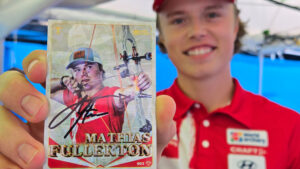
For the first series, Titan Sports deliberately chose internationally successful athletes, including Brady Ellison, Lim Si-hyeon, Deepika Kumari and Ella Gibson – the elite of our sport. „We wanted to show the level we are aiming for, both athletically and in terms of design,“ Vanessa says.
Most of the cards were handed to the athletes personally. Vanessa travelled specifically to competitions and World Cups to present them. „The reactions were incredible. Some were genuinely overwhelmed. A few said they never thought they would ever be on a trading card,“ she recounts.
From the very beginning, it was clear that a portion of the proceeds would go directly to the athletes. „We couldn’t do this and keep everything for ourselves. The project was meant to be for archery from the outset,“ Vanessa says.
The team invests considerable time and personal funds into the project, without any short- term financial gain. The focus is on visibility for the athletes and for archery itself – a level of commitment that is far from commonplace in today’s sports landscape.
Info:
Challenges, Opportunities & Economic Reality
Despite the positive response, Titan Sports remains a project with clear limitations. The first series was financed entirely from personal savings, without external investors. „None of us is earning money from this at the moment. We all have other jobs,“ Vanessa says. For her, the ideological value of the project clearly outweighs any financial considerations: working on Titan Sports allows her to combine skills from the tech sector with her experience in archery, while at the same time doing something meaningful for the athletes.
Next Steps and Visions
Series 2 is already in preparation. When asked whether para-athletes or younger archers will be included, Vanessa responds clearly: „Yes, we want to represent the sport more broadly – both junior athletes and para-athletes should be part of the series.“ Historical figures in archery are also a potential topic, to make the sport’s history and development more visible.
Beyond that, the team is thinking about possible new elements that could further strengthen the collecting and interaction aspects. Vanessa describes the vision: „You could imagine fans assembling their own bow – with risers, limbs and accessories, similar to their role models.“ Trading features, digital twins of the cards and gamification elements are also being considered as ideas to enable interactive experiences or on-site events. These are future perspectives – directions the project could take – not features that have already been fully implemented.
One concrete goal is a planned event in Las Vegas, where such ideas are to be tested and presented on a larger scale for the first time. Vanessa emphasises: „We don’t just want to showcase the athletes, but also convey the excitement for the sport itself and the technology behind it.“
The team is also considering similar projects in other sports that currently receive little media attention. When and how such concepts might be realised remains open – what matters most to Vanessa and Brody is that every implementation remains authentic and offers genuine added value for both athletes and fans.
Overall:
Titan Sports is neither a classic merchandising project nor a complete solution to the structural challenges facing archery. It is an additional building block – initiated by people from within the sport itself, with a clear focus on design, visibility and appreciation of the athletes.
The team brings fresh ideas to archery without losing sight of its roots. The combination of physical collectible cards, digital extensions and a strong athlete-centred approach shows how innovation can work when it grows out of the sport itself. The series, designs and technological concepts highlight the potential of a project built on expertise, passion and a deep understanding of archery.
At the same time, the cards carry a special collector’s value: as the first trading cards of their kind in archery, they mark the beginning of a development that makes it exciting to be involved from the very start. Ultimately, one impression remains above all – that initiatives like this give niche sports a platform and open up new ways to make sport visible and tangible.
And What Do You Think?
Have do you eaty oren he or making tracing arde more as e enouge el sctie
In europe in the tear s curenty in iscussions about making the cards more accessible And we’re especially interested in your opinion: which athletes would you like to see on a card? Send us your thoughts and ideas at social@bogensport-magazin.de – we look
forward to hearing from you.
(Fotos: Vanessa Lee)
